August 3, 2026
Planning a Multi-Family Ski Trip? Why Two Living Spaces Matter
Planning a multi-family ski trip to Breckenridge? See why a large group cabin with two living rooms makes meals, bedtimes, downtime, and mixed ski schedules easier.
The Ski Trip Usually Is Not the Hard Part
Getting two or three families onto the same mountain sounds simple enough. Pick dates, buy lift tickets, reserve a large group cabin near Breckenridge, and spend the week making effortless memories.
Then the actual people arrive.
One family wants first chair. Another has a child who needs an hour to locate both gloves. A teenager would prefer not to speak before noon. Someone is taking a rest day, someone is cooking breakfast, and the youngest skier is done by 1:30 p.m. with the emotional finality of a tiny union representative.
This is normal. A multi-family ski trip brings together different routines, budgets, ski levels, bedtimes, and definitions of “early.” The lodging layout determines whether those differences feel manageable or whether every change of plan becomes a group negotiation.
Bedroom count matters, but it is only part of the answer. For a group sharing one house, two living spaces can matter just as much.
A Large Group Cabin Is More Than Its Bed Count
When families compare Breckenridge rentals, the first filter is usually occupancy. Can everyone sleep there? Good. Necessary question.
The better follow-up is: where will everyone be when they are awake?
A house may technically sleep ten while giving those ten people one sofa, one television, and one shared room for every conversation, snack, game, and post-ski collapse. That setup works while everyone is out. It gets considerably less charming when weather changes, a child needs a nap, or half the group returns early.
For a multi-family ski trip, look beyond beds and count the usable gathering areas. Two living rooms give the group options without forcing anyone to retreat to a bedroom. Adults can talk upstairs while kids play downstairs. Non-skiers can have a quiet afternoon without being drafted into a foosball tournament. One family can wind down while another is still awake.
That separation is not about avoiding each other. It is what helps everyone enjoy being together for several days.
Different Ski Schedules Need Different Landing Zones
Even families that arrive together rarely move through a ski day in formation.
Experienced skiers may leave early and return late. Beginners might finish after lunch. Parents trade off childcare. Someone takes a day away from the slopes. Boots, helmets, mittens, snacks, and damp layers appear in waves rather than all at once.
With one common room, each return resets the entire house. The early group turns on the television. The later group comes in talking over it. Someone wants to stretch out. Someone else wants to play a game. The person who stayed home has now heard the front door open eleven times.
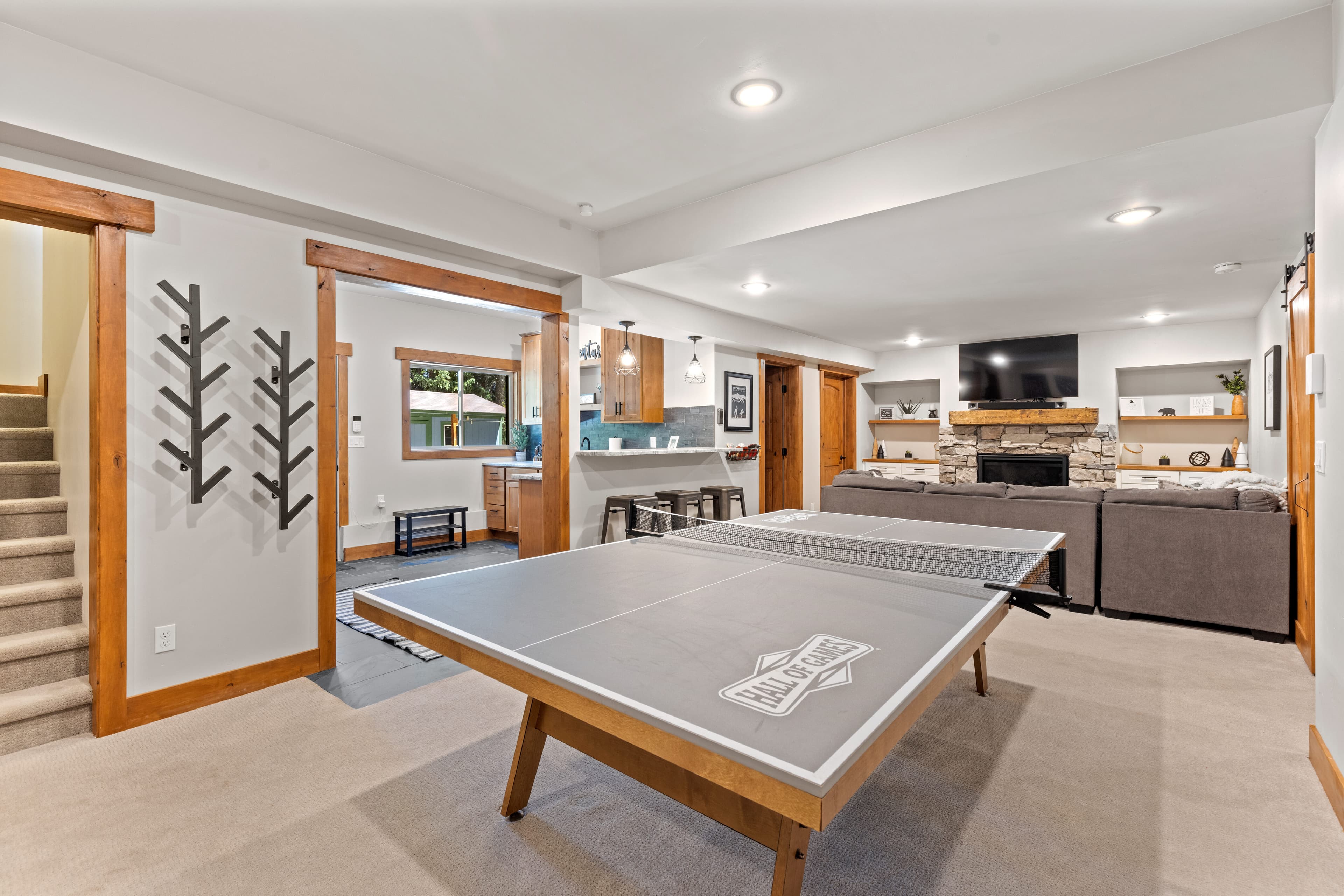
Two living spaces absorb that traffic. At Lodestone Retreat, the main-level living area is centered around a wood-burning stove, with the kitchen and dining area nearby. The lower level has its own seating and TV area, plus ping pong, games, and a wet bar. Groups can naturally split based on what they want to do instead of holding a summit every time the plan changes.
The result is a looser schedule, which is usually the secret to a better group ski trip.
Kids Get a Real Place to Go
“Go play downstairs” may be one of the most useful sentences in multi-family travel.
A separate family room gives kids and teens a place that feels like theirs. They can play ping pong, watch a movie, start a board game, or simply sprawl without taking over the only shared space. The bunk room and a full bathroom are also on Lodestone Retreat's lower level, so that part of the house works as a natural kid-friendly zone.
Meanwhile, adults can cook, sit by the stove, or have a conversation that lasts longer than 40 seconds. Everyone remains under one roof, but not necessarily within arm's reach.
This becomes especially valuable after skiing. Adults may be pleasantly exhausted. Children often return with an unexplained second shift of energy. A game-friendly lower level gives that energy somewhere productive to go.
Adults Need Somewhere to Be Adults
Multi-family trips are often planned around the kids, but the adults are supposed to be on vacation too.
Once younger children are asleep, parents should not have to choose between whispering in the kitchen and going to bed at 8:15. A second living area creates distance between quieter evening conversation and the rooms where people are sleeping. It also lets adults divide naturally: some can relax upstairs, others can use the hot tub, and the highly competitive wing of the group can continue downstairs.
The same principle works in the morning. Early risers can make coffee and sit in the main living area without requiring every bedroom to begin the day at once. Late sleepers are granted mercy. Skiers trying to make first chair can organize themselves without turning the entire house into an airport terminal.
Bad-Weather Days Stop Feeling Like Lost Days
Mountain plans are weather-dependent. Wind, snow, road conditions, illness, or plain fatigue can shorten a ski day. Sometimes the smartest choice is to stay in, and that should not make the rental feel like a waiting room.
Two living rooms give a large group cabin enough flexibility for a full day at home:
- A movie downstairs while someone reads upstairs
- Board games in one room and a football game in the other
- A quiet space for a child who needs downtime
- Room for someone to answer a work call without exiling everybody else
- Separate activities for different ages and attention spans
- A place to spread out wet gear without surrendering every chair
This is when square footage starts earning its keep. A ski trip should not depend on every person wanting the same activity at the same time.
Shared Meals Work Better When the Group Can Spread Out
Cooking at the house is one of the easiest ways to control costs on a multi-family ski trip. It also avoids moving a large party into town for every meal, which can become its own winter sport.
A full kitchen and dining area handle the meal itself. The second living space handles everything around it.
Children can play downstairs while adults cook. One family can eat an early snack without interrupting dinner prep. Afterward, some people can clear the table while others move to the game room. The kitchen does not have to function as restaurant, lounge, playroom, and command center all at once.
Before the trip, divide meal responsibility rather than splitting every grocery receipt down to the avocado. A simple system works well:
- Assign each family one dinner
- Plan easy breakfasts at the house
- Keep lunch flexible for different ski schedules
- Stock one low-effort backup meal for the night everyone is tired
- Agree in advance which meals will be in town
The goal is not perfect accounting. It is fewer daily decisions.
Two Living Spaces Help With Mixed Ages, Too
A multi-family ski trip often includes more than children and parents. Grandparents may join, or one family may have toddlers while another has teenagers. Those age groups do not share a schedule merely because their names are on the same reservation.
Separate living areas make it easier to accommodate:
- Early bedtimes and later evenings
- Quiet mornings and energetic ones
- Skiers and non-skiers
- Screen time and screen-free time
- Conversation, games, and reading happening at once
Lodestone Retreat has four bedrooms and 3.5 bathrooms across three levels, with a maximum occupancy of ten guests. The split-level design is useful for separation, but it also means stairs between floors. If anyone in the group has significant mobility limitations, review the layout carefully before booking. The FAQ covers accessibility, parking, winter driving, check-in, and other logistics worth settling before the group chat gains momentum.
How to Choose a Rental for a Multi-Family Ski Trip
Photos can make every large group cabin near Breckenridge look spacious. A floor plan, room list, and a few pointed questions tell you more.
Count Common Spaces, Not Just Bedrooms
Confirm that the second living room is a real gathering space with seating, not a landing with a television mounted on the wall. Look for rooms that different parts of the group can comfortably use at the same time.
Check Where Bedrooms Sit
Bedrooms spread across levels can create useful separation. They can also matter for parents with young children or guests who avoid stairs. Decide who will sleep where before arrival rather than staging a suitcase-based land rush at check-in.
Look at Bathrooms by Level
The total bathroom count matters, but location matters too. A bathroom near the game room or bunk area keeps the whole group from migrating upstairs every ten minutes.
Plan for Gear
Ask where coats, boots, helmets, and gloves will go. Ten guests produce a surprising amount of equipment, and somehow every black glove belongs to nobody.
Check the Kitchen Honestly
If the group plans to cook, verify the home has a full-size refrigerator, oven, stove, dishwasher, cookware, dishes, and enough room to prep. “Kitchenette” is not an encouraging word when dinner is for ten.
Give the House a Job on Rest Days
A strong ski rental should still work when nobody skis. Games, multiple TVs, comfortable seating, WiFi, a hot tub, and space to separate can turn a rest day into part of the vacation instead of an interruption.
Set a Few Expectations Before Arrival
The layout can solve many group problems. It cannot solve a group that has never discussed money, meals, transportation, or childcare.
Before the trip, agree on a few basics:
- How costs will be divided. Equal shares are simple, but families may prefer to account for bedroom size or number of guests. Decide before anyone pays a deposit.
- Who is driving. Mixed ski schedules are easier with more than one vehicle, especially when beginners or young children may return early.
- Which meals are shared. Do not assume all ten people want every meal together.
- How childcare will work. If adults plan to trade off, set the rough schedule before the first ski morning.
- What quiet time looks like. Children, teenagers, and adults all benefit from knowing where louder evening activities belong.
The point is not to schedule every hour. It is to remove the handful of recurring questions that otherwise consume every hour.
Why Lodestone Retreat Works for Multiple Families
Lodestone Retreat is a 4-bedroom mountain home in Blue River, two miles south of Breckenridge. It sleeps up to ten guests and has two distinct living spaces: a main-level gathering area near the kitchen and dining room, and a lower-level family room with a TV, wet bar, ping pong, foosball, board games, and additional seating.
The layout lets the group come together for meals and evenings without requiring everyone to do the same thing. Kids can claim the game area. Adults can settle near the wood-burning stove. Tired skiers can find a quiet corner. The private hot tub provides one more place to rotate through after a day outside.
Browse the property photos, bedrooms, and amenities, then check the FAQ with your group's sleeping arrangements and mobility needs in mind. If the layout fits the way your families actually travel, check your dates directly.
Plan Your Blue River Getaway
Book your stay at Lodestone Retreat — a spacious 4-bedroom mountain home just 2 miles from Breckenridge.
Check Availability